Singapore ACM SIGKDD Symposium 2024

On 31 July 2024, the Singapore Chapter of SIGKDD organized a full-day symposium. It was a rich program that among other things featured presentations of papers by authors based in Singapore that had been accepted in recent conferences such as KDD-24, SIGIR-24, ICML-24, IJCAI-24, WWW-24, ACL-24, NeurIPS-23, etc. The event was attended by more than 50 participants from various universities and companies.

Hady Lauw (Chapter Chair) opened the session and introduced the chapter and the day’s schedule

The day featured three invited talks on various topics. The first morning talk was given by Zhenhua Dong, who gave us comprehensive perspectives on biases in recommender system, covering both out of distribution and unfairness. The second morning talk was given by Wenxuan Zhang, who took us through the several interesting works in advancing multilingual large language models. The afternoon talk was given by Shonali Krishnaswamy, who gave a captivating sharing of her successful AI startup journey.

Invited speakers Zhenhua Dong and Wenxuan Zhang providing useful insights to the audience

For the first time, we ran the presentations along two tracks: Research Track, managed by Yuan Fang and Cheng Long, as well as Applied Data Science Track, managed by Yong Liu and Wee Siong Ng. The research track featured seven oral presentations and eleven posters, while the applied data science track featured two oral presentations.

The oral sessions showcased recently published papers by Singapore-based authors

At the end of the day, we announced several awards based on audience feedback, but the reality was that all attendees won, because we all gained insights and friendships.

Singapore ACM SIGKDD Symposium 2023

On 19 July 2023, the Singapore Chapter of SIGKDD organized a full-day symposium. It was a rich program that among other things featured presentations of papers by authors based in Singapore that had been accepted in recent conferences such as KDD-23, SIGIR-23, ACL-23, IJCAI-23, etc. It was a time for learning as well as networking and fellowship, attracting 70 participants with significant representations from both industry and academia. The event was sponsored by Huawei, as well as SMU School of Computing and Information Systems.

Below is a brief photo-story of the event.

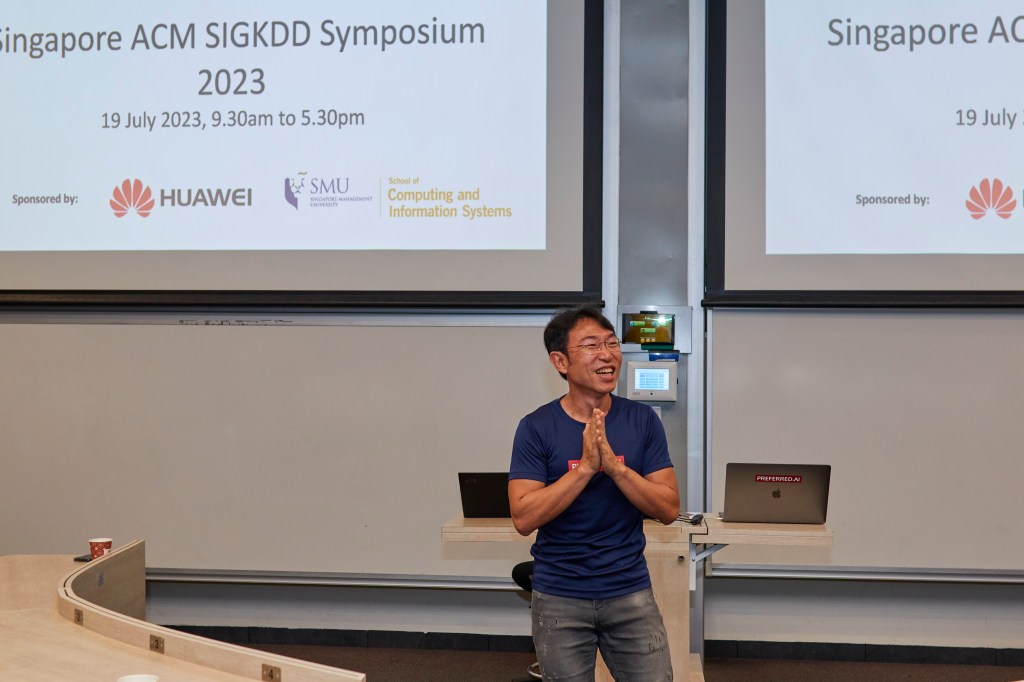
Hady Lauw (SIGKDD Chapter Chair & Associate Professor, Singapore Management University) opened the session by introducing the Singapore ACM SIGKDD Chapter.
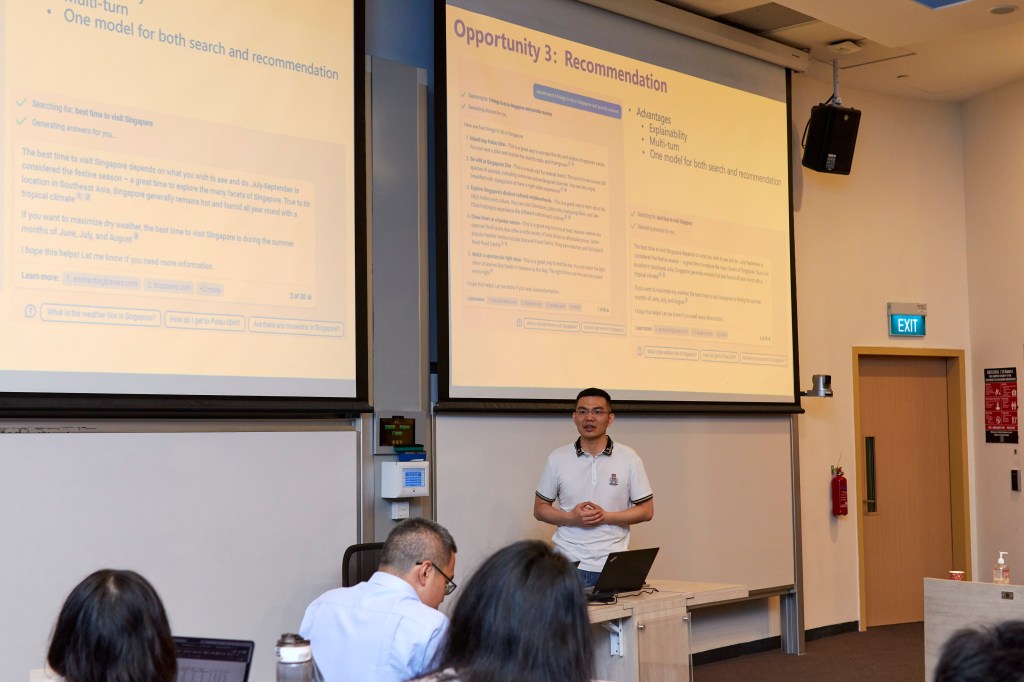
Rui Zhang (Principal Researcher at Huawei and Visiting Professor at Tsinghua University) discussed the opportunities and challenges of large language model-based information retrieval.
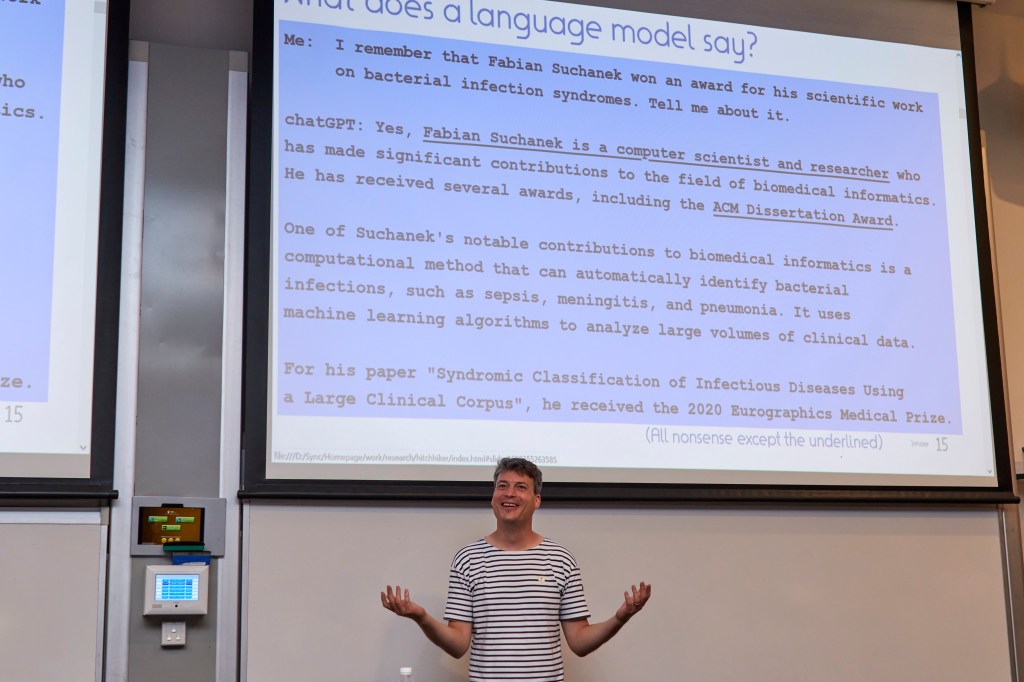
Fabian Suchanek (Professor at Télécom Paris University/ Institut Polytechnique de Paris in France) presented a well-received invited talk on ontologies, engaging the attendees throughout and concluding to a rousing round of applause.
The afternoon featured a wide-ranging discussion on data science for smart nation, with a diverse panel, featuring (from left) See-Kiong Ng (Professor at NUS), Jing Jiang (Professor at SMU), Jinmiao Chen (Principal Investigator at A*STAR), and Zhongwen Huang (Director of Smart City Projects Office).
The programme featured 9 papers as oral presentations, with representations not only from various conferences, but also from the local universities including NUS, NTU, SMU, and SUTD.
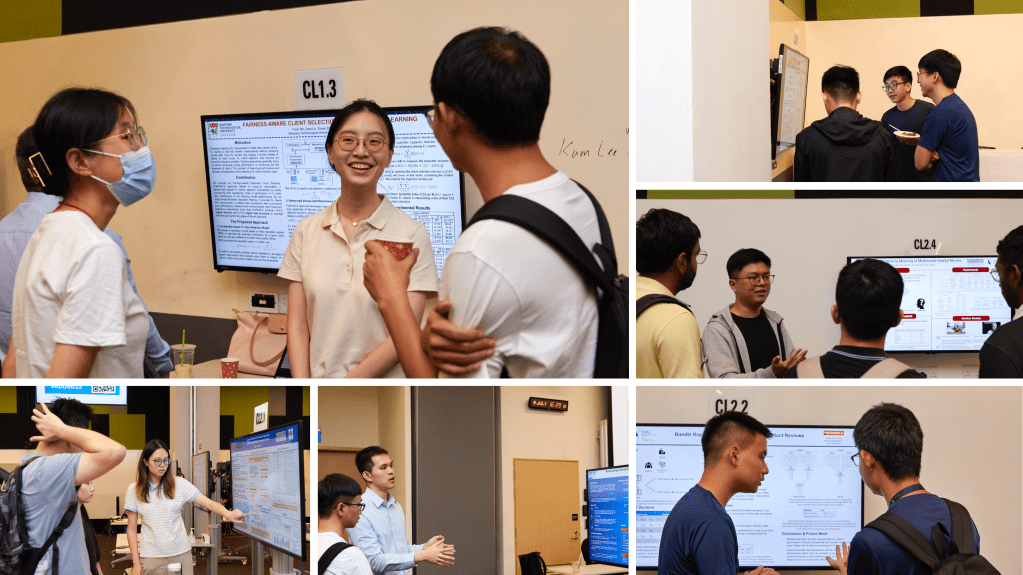
Another 10 papers were presented as digital posters, projected on a 49″ monitor. In addition, there were 3 posters that were work-in-progress, and we hope that some of them would eventually appear in some future KDD conference.
Importantly, our objective was also to gather people for networking and fellowship. In science, as in other endeavours, it’s important not just what you know, but also whom you know, for collaborations and ideas keep flowing.
Any gathering in Singapore would not be complete without food. Wow, there was food galore. Some even commented that the food might be better than some conferences where the presented papers were originally accepted.

We’re certainly excited to do this all over again. Keep a look out for our next event!

Let’s Get Connected with KDD.SG Seminar on Graphs

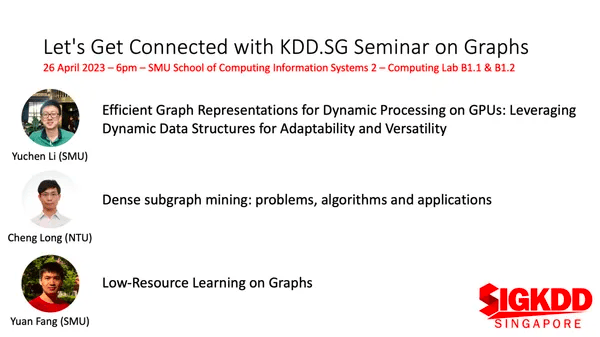
In this seminar by KDD.SG held on April 26, 2023, we featured three experts on graphs.

Talk #1: Title: Efficient Graph Representations for Dynamic Processing on GPUs: Leveraging Dynamic Data Structures for Adaptability and Versatility

Abstract: Dynamic graph processing has become increasingly important in various fields, such as social network analysis, disease surveillance, and transaction monitoring, where graphs evolve over time or need to be analyzed in real-time. Graphics Processing Units (GPUs) offer massive parallelism and high computational power, making them an ideal choice for processing large-scale dynamic graphs. However, efficient processing of these dynamic graphs on GPUs demands adaptive and versatile graph representations. In this talk, we delve into the design of innovative graph representations that enable efficient dynamic graph processing on GPUs. We will discuss the characteristics of our graph representation, which utilizes dynamic data structures to cater to different update requirements. By highlighting the importance of adaptability and versatility in graph representations, attendees will gain valuable insights into optimizing dynamic graph processing on GPUs and be better equipped to enhance their own graph-based applications.

Bio: Yuchen Li is an assistant professor with the School of Computing and Information Systems, Singapore Management University (SMU). He received double BSc degrees in applied math and computer science (both with first-class honors) and a Ph.D. degree in computer science from the National University of Singapore (NUS), in 2013 and 2016, respectively.

Talk #2: Dense subgraph mining: problems, algorithms and applications

Abstract: A graph represents a set entities as vertices and the relations among the entities as edges and is used for modelling data in many applications. A subgraph of vertices in a graph, which are connected via many edges, is called a dense subgraph and often conveys meaningful knowledge of the graph. Finding dense subgraphs in a graph has a wide range of applications including correlation mining, fraud detection, e-commerce, bioinformatics, frequent pattern mining, and community detection, etc. In this talk, I will first introduce some representative applications, density measures and problems of dense subgraph mining. I will then present several of our recent studies of finding dense subgraphs in bipartite graphs and uncertain graphs and their applications in fraud detection, community search, and fake news detection. Finally, I will discuss some potential future work directions.

Bio: LONG Cheng is currently an Assistant Professor at the School of Computer Science and Engineering (SCSE), Nanyang Technological University (NTU). He got the PhD degree from Hong Kong University of Science and Technology (HKUST) in 2015. His research interests are broadly in data management and data mining.

Talk #3 Low-Resource Learning on Graphs
Abstract: Graph structures are ubiquitous in various domains, ranging from social networks and e-commerce platforms to transportation and biological systems. On these graphs, various graph-based analytics and mining tasks exist, many of which can be cast as instances of link prediction, node classification, and graph classification. Moving away from manual feature engineering, graph neural networks (GNN) have witnessed widespread success in various application scenarios due to their ability to learn powerful graph representations automatically. However, their success is often dependent on the availability and quality of graph structures and labeled data, without which their performance can suffer. In this talk, we explore alternative learning paradigms different from the traditional supervised learning paradigm, specifically addressing two types of low-resource scenarios on graphs: structure scarcity and label scarcity. We will first provide an overview of low-resource problems and methods on graphs, and then introduce some of our representative works on these problems.

Bio: Dr. Yuan Fang is an Assistant Professor at the School of Computing and Information Systems at Singapore Management University (SMU). He was previously a data scientist at DBS Bank and a research scientist at A*STAR. His research interests revolve around graph-based learning and its applications in recommender systems, social network analysis, and bioinformatics.

KDD for a Safer Online Social Space

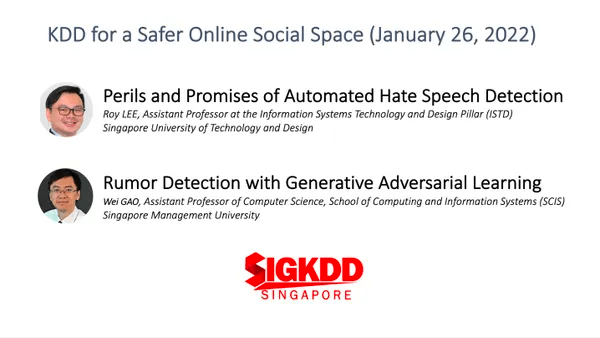
On January 26, 2022, SIGKDD Singapore held an online lunch-time seminar featuring two talks on KDD for a Safer Online Social Space by two experts in the field.


Talk#1: Perils and Promises of Automated Hate Speech Detection

Abstract: Online hate speech is an important issue that breaks the cohesiveness of online social communities and even raises public safety concerns in our societies. Motivated by this rising issue, researchers have developed many traditional machine learning and deep learning methods to detect hate speech in online social platforms automatically. This talk aims to introduce the pressing problem of online hate speeches and discuss the automated hate speech detection methods. Specifically, we will discuss the various NLP approaches for hate speech detection and highlight the potential future research directions such as multimodal and multilingual hate speech detection.

Bios: Roy is an Assistant Professor at the Information Systems Technology and Design Pillar, Singapore University of Technology and Design. He is a faculty of the transformative Design and Artificial Intelligence program. His research lies in the intersection of data mining, machine learning, social computing, and natural language processing. He is leading the Social AI Studio, a research group that focuses on designing the next-generation social artificial intelligence systems. He has published in top-tier venues in data mining and computation linguistics domains. He serves in the program committees of multiple top conferences. He is currently part of the editorial board for the Social Network Analysis and Mining journal.


Talk#2: Rumor Detection with Generative Adversarial Learning

Abstract: Online rumors can cause devastating outcomes to individuals and society. Analysis shows that the widespread of rumors typically results from deliberate promotion of uncredited information aiming to shape the public opinions. On the other hand, fact-checking currently follows investigative journalism requiring significant amount of time and manual effort, which cannot keep the pace of generation of various rumors on a daily basis. In this talk, I will introduce automatic approaches, techniques and new development for combating online rumors in social media from the perspective of natural language processing and adversarial learning. I will also discuss the characterization of online rumors including their linguistic, temporal and propagational features and dynamics, together with some takeaways from past and ongoing research.

Bio: Wei Gao is currently an Assistant Professor of Computer Science at Singapore Management University. His research generally interests natural language processing, information retrieval, artificial intelligence and social computing. Currently he has been working on the topic of rumor detection and computational fact checking. His publications appear in the major international venues including ACL, AAAI/IJCAI, SIGIR, WSDM, WWW, ACM TOIS, IEEE TKDE, etc. He broadly serves the top conferences and leading journals in his relevant field. He is an Associate Editor of ACM TALLIP and a member of standing review committees of Transactions of the ACL and Computational Linguistics Journal.

KDD.SG Seminar organized by SIGKDD Singapore & OpenMined

On 24 October 2019, in collaboration with Singapore OpenMined, we feature two speakers in our KDD.SG Seminar series, this time hosted at SMU School of Information Systems.

IMG_3416

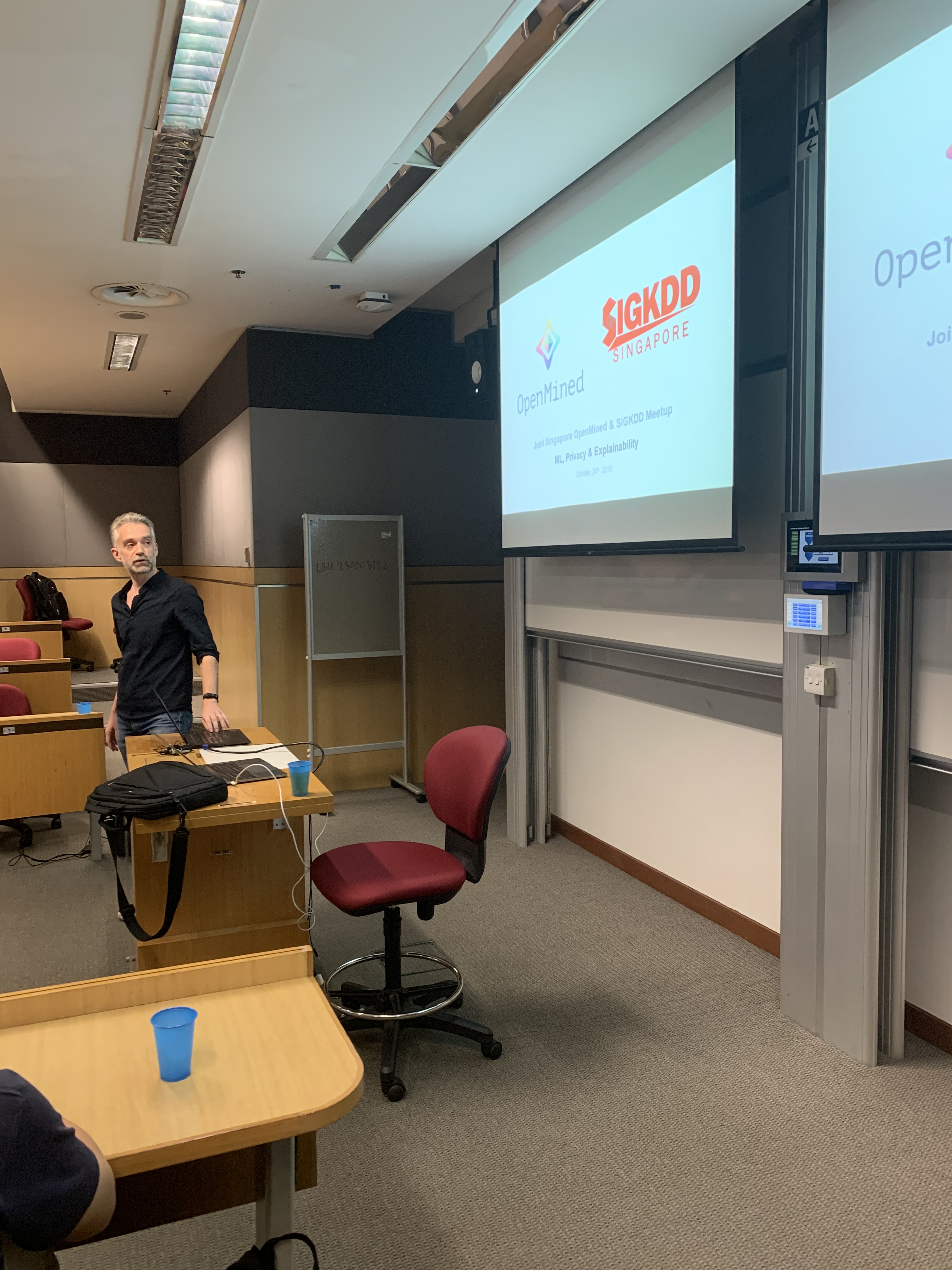
Dr Markus Kirchberg represented OpenMined to open the session 

The first talk on data privacy in machine learning was given by Assistant Professor Reza Shokri, who is NUS Presidential Young Professor.

IMG_3417

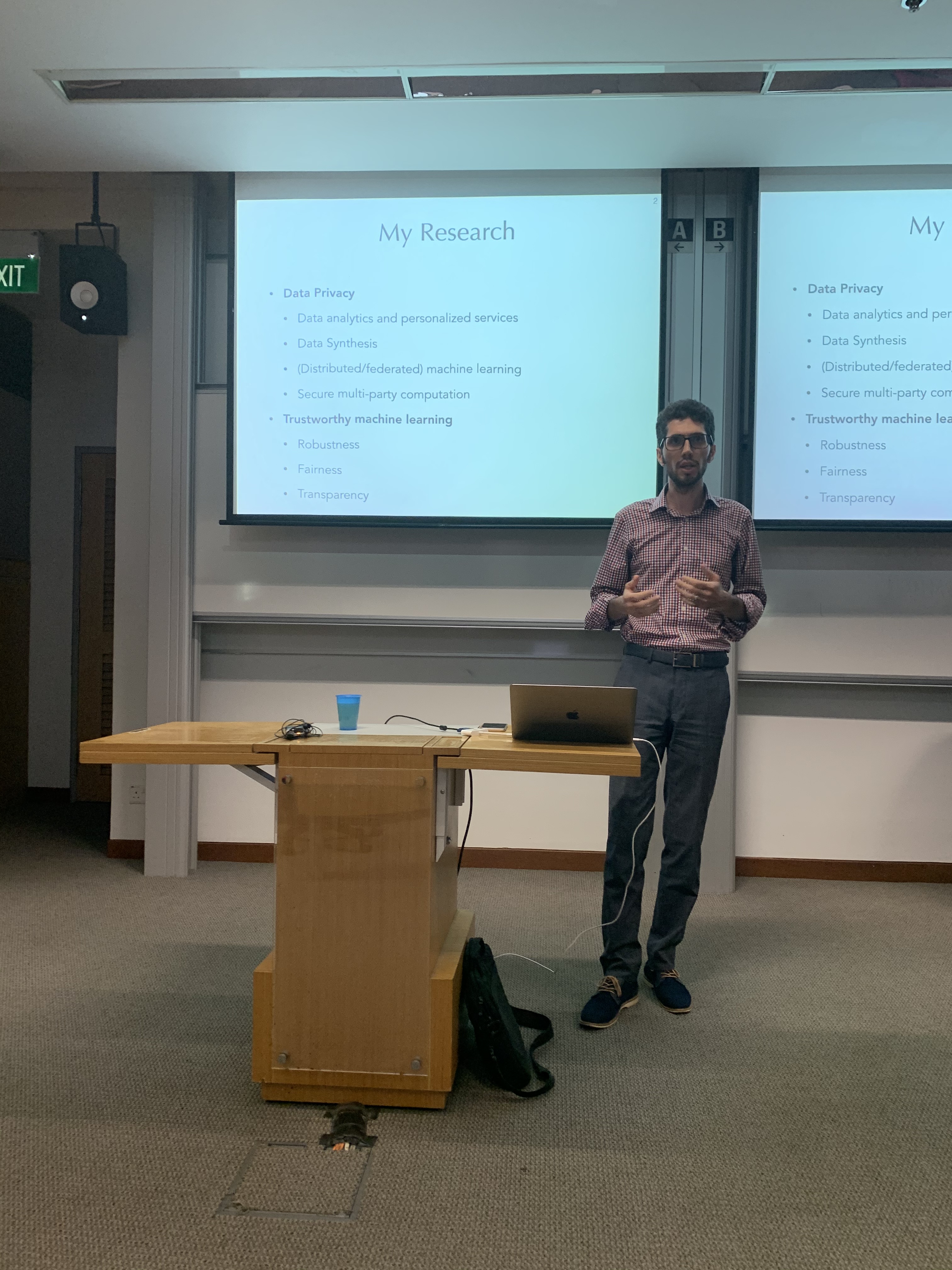
Reza introduced his research on data privacy and trustworthy machine learning

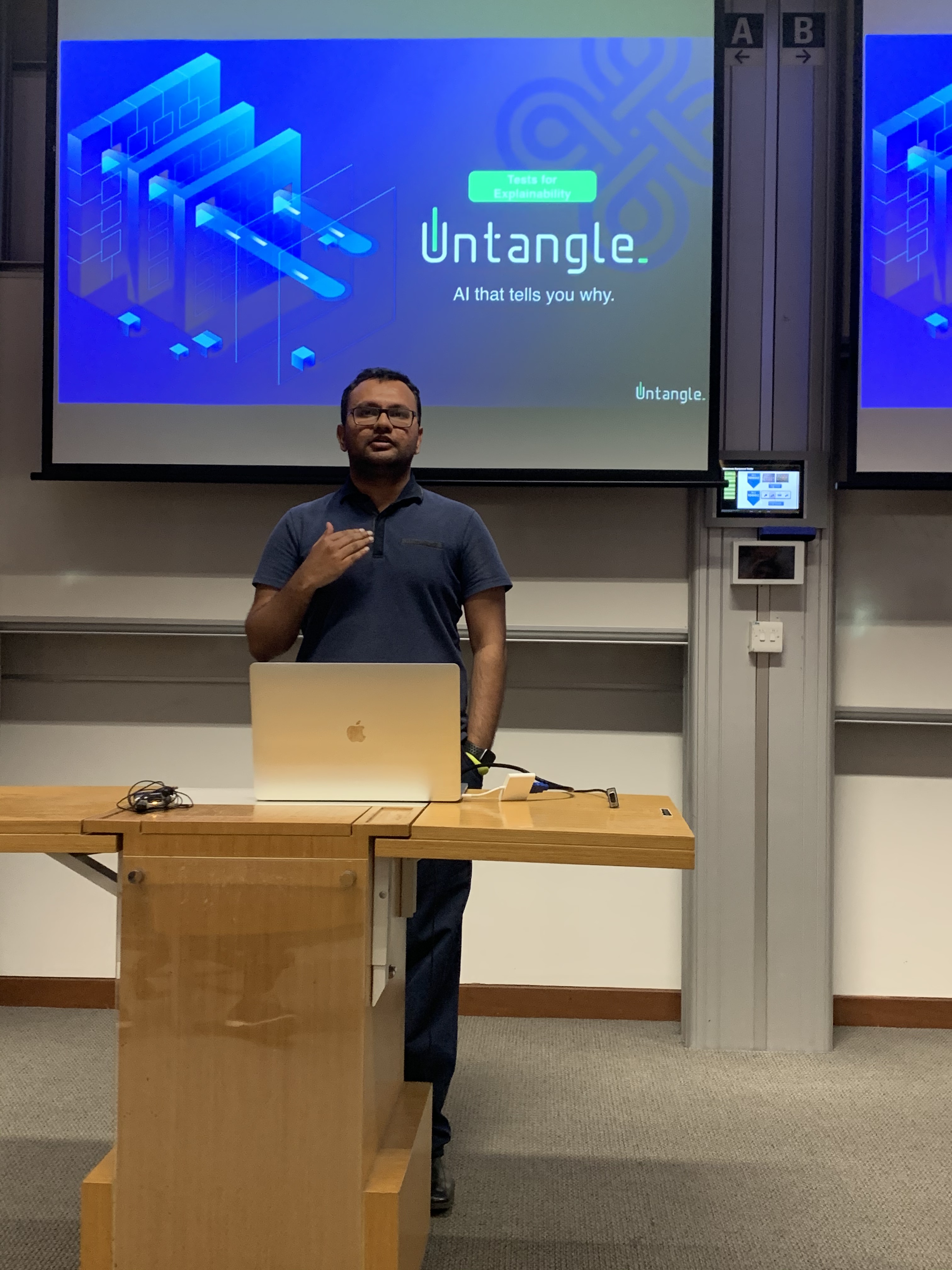
The second talk on tests and metrics to evaluate machine learning model explanations was given by Naresh Rajendra Shah, who is Co-founder and CTO at Untangle AI.

IMG_3420

Naresh on how we could evaluate explanation for a machine learning model

We thank both speakers as well as OpenMined for what turned out to be a mind-opening experience for all the attendees.